metric · 01
Full frontend
React, MapLibre GL, custom tile rendering. Replaces the prior internal-only tool with a public-facing surface. Designed for landowners and developers, not just lab staff.
case study · 05
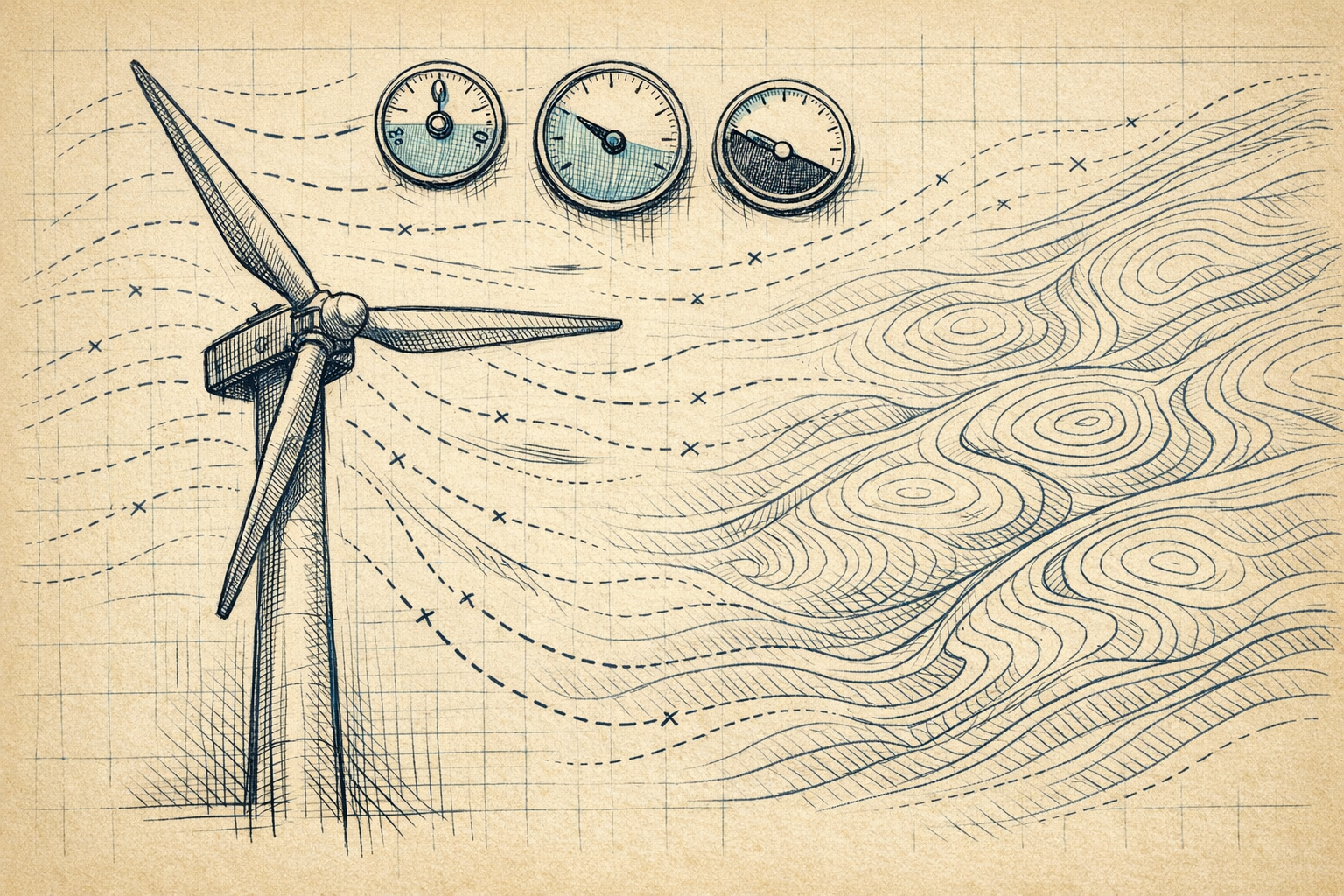
Wind turbine output, mapped over real terrain, in the browser.
Geospatial production-mapping tool for the National Lab of the Rockies. Full frontend rebuild plus a thin tile-server, deployed publicly at windwatts.nlr.gov. Surfaces a federally-funded wind dataset for landowners, developers, and researchers.
~ what shipped ~
metric · 01
Full frontend
React, MapLibre GL, custom tile rendering. Replaces the prior internal-only tool with a public-facing surface. Designed for landowners and developers, not just lab staff.
metric · 02
Public deploy
Hosted at windwatts.nlr.gov on the National Lab of the Rockies infrastructure. Real data, real users, real production posture. Not a demo.
metric · 03
Federal scrutiny
Data accuracy non-negotiable: every value on screen ties back to the source dataset and the model that produced it. UI cannot ever lie about the underlying numbers.
Federal-funded data products have an unusual bar: every number rendered on screen has to be defensible to the source. That changes how the UI gets built. No client-side smoothing, no rounding for aesthetics, no inferred values where the user thinks they're reading actual data. The map has to mean what it shows.
Source data lives in NLR's pipeline, output as gridded raster. The frontend consumes pre-rendered vector tiles served from a thin Node tile-server. Visible-resolution scaling happens at the tile boundary, not in the browser. User pans and zooms feel real because the data is real.
The original users were lab researchers. The new audience is everyone: landowners checking economic viability, developers scoping a parcel, hobbyists asking how much wind their backyard gets. The redesign had to read for all three without dumbing down for any. Hovering a tile shows the headline number in plain language; clicking reveals the model lineage and the underlying grid value.
↳ when the data has to be right and the UI can't get in the way.
~ on the workbench ~
~ counterfactual ~
Without it: a federally-funded wind dataset stays trapped in PDFs and spreadsheets. Landowners considering wind installations don't know what's economically viable on their parcel. Developers run their own surveys at hundreds of thousands of dollars per site. The science exists; the surface to use it doesn't, and nobody benefits from a dataset locked behind an internal SAML login.
~ got something like this on the bench? ~
/ windwatts / built by hand / shipped to a working URL /